Sunday, October 03, 2010

Oracle 11.2.0.2 (out-of-place install)

From the first patchset of Oracle 11gR2 (11.2.0.2), we are able to install it from “scratch” without having the need to install the based version (in most of the case *.1, e.g. 11.2.0.1), called out-of-place install or upgrade.
This is rather nice for any new installation, let’s say you start a brand new project, you want to be on the latest patchset. No need anymore to do it in two steps (first 11.2.0.1 then 11.2.0.2), you can directly install the latest available patchset.
Moreover, the Installer offers also the possibilities to install the latest PSU (PatchSet Update, a set of one-off patches and CPU) within a special step.

So, why waiting more, let’s install it.
From the
patchset page download on MOS, we can see 7 zipped files (!), but each one is for different usage :
* Files 1_of_7 and 2_of_7 are for Database
* Files 3_of_7 are for Grid Infrastructure
* Files 4_of_7 are for the Client
* Files 5_of_7 are for Gateway
* Files 6_of_7 are for Examples
* Files 7_of_7 are for Deinstaller

Don’t download everything if you don’t need, in the case below, only the first two are in used. I would say name of files would have been choose more carefully…
The install below is on Linux x86_64 OEL5.3.

 
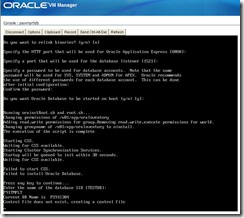
Oracle11gR2.2_001 Oracle11gR2.2_002 Oracle11gR2.2_003

Oracle11gR2.2_004
 Oracle11gR2.2_005  Oracle11gR2.2_006
Oracle11gR2.2_007
The screen above is new from 11.2.0.2, you are prompted for email/password of My Oracle Support in case you want to apply the latest PSU, rather nice ! (in our case there is not). 
Oracle11gR2.2_008    Oracle11gR2.2_009 Oracle11gR2.2_010
Oracle11gR2.2_011  
Oracle11gR2.2_012
Remember, I’m doing an out-of-place installation (not based on any previous installation), and I already have a 11.2.0.1 installation on the same server, that’s why my oracle home directory contains the patchset number. It could become a name convention as of now.
Oracle11gR2.2_013   Oracle11gR2.2_014 Oracle11gR2.2_015  Oracle11gR2.2_016   Oracle11gR2017  
Right now, I have two Oracle home for 11gR2 (11.2.0.1 and 11.2.0.2), so, I modified my .bash_profile to be able to switch from one to the other easily :

[root@orion3:/]# su - oracle
[oracle@orion3:/home/oracle(OH-11.2.0.1)]$ more .bash_profile
# .bash_profile

# Get the aliases and functions
if [ -f ~/.bashrc ]; then
        . ~/.bashrc
fi

# User specific environment and startup programs

PATH=$PATH:$HOME/bin

export PATH

export ORACLE_BASE=/apps/oracle

settings()
{
export ORACLE_BIN=$ORACLE_HOME/bin
export PATH=$ORACLE_BIN:$PATH
export LD_LIBRARY_PATH=$ORACLE_HOME/lib:$LD_LIBRARY_PATH
}

o1()
{
export ORACLE_HOME=$ORACLE_BASE/product/11.2.0
PS1="[\u@\h:\$PWD(OH-11.2.0.1)]\\$ "
settings
}

o2()
{
export ORACLE_HOME=$ORACLE_BASE/product/11.2.0.2
PS1="[\u@\h:\$PWD(OH-11.2.0.2)]\\$ "
settings
}

o1
[oracle@orion3:/home/oracle(OH-11.2.0.1)]$ sqlplus -v

SQL*Plus: Release 11.2.0.1.0 Production

[oracle@orion3:/home/oracle(OH-11.2.0.1)]$ o2
[oracle@orion3:/home/oracle(OH-11.2.0.2)]$ sqlplus -v

SQL*Plus: Release 11.2.0.2.0 Production

[oracle@orion3:/home/oracle(OH-11.2.0.2)]$

There are a couple of new features coming within this patchset, find out more in the documentation. I like the point 2.1.1.4 (While truncating a table or partition, you can now specify whether or not to keep any segments), it has been discussed several times over here. It is also now the case for partitioned table, point 2.1.1.15.

Enjoy the new version !

Nicolas.

Saturday, October 02, 2010

Peoplesoft and Oracle Edition

What Edition of Oracle database is required for Peoplesoft application ? Easy question, obvious answer ? Not so obvious.

In most of cases, response will be Enterprise Edition. But Peoplesoft works also fine with a Standard Edition as well. See the MOS note
PeopleTools Certification FAQs - Database Platforms - Oracle [ID 756280.1].
If you are not using any of the Enterprise options and features, then you definitely should consider the Standard Edition, it could dramatically drop your license costs down.
Of course, before changing or going for Standard Edition, you should double check your architecture and see further if you really need the Enterprise Edition or not.
For instance, you may not need Partitioning, not DataGuard (maybe a third party tool), not need Total Recall, not need Fine-Grained Auditing, not need Database Vault, no Advanced and Label Security neither (to name only few major features and options)… Then Standard Edition is probably more accurate for you.
Few features are really missing, like Flashback table (only Enterprise Edition feature) which really might help and be useful, and the main limitation being the 4 sockets max.
Find out which Edition is for you
here according to your environment and requirements.
If you eventually decide to move from Enterprise to Standard Edition, the procedure is quite simple, export and import, well
documented.

Was it new for you ? So, what Oracle Edition are you using in your Peoplesoft environment ? Would you consider a change for a cost cutting ?

Nicolas.

Friday, September 24, 2010

OOW2010 – day 5

Last day, but not least. Again, a couple of interesting sessions.

The first was “PeopleSoft PeopleTools Release 8.51 Highlights: PeopleSoft Integration Broker” (David Bain), with several new features for the Integration Broker : documents for the metadata structure creation and validation (non-Peoplesoft data structure), Peoplecode against non-rowset data, WSDL limited. An interesting feature is the document tester. In addition, of Best effort Delivery, Delay processing, FTP, inbound request load-balanced, parallelism of large messages processing, new algorithm of messaging load-balancing. In the futures releases, we could see even more : Peoplesoft Integration Network (simplified configuration and setup), monitoring, introspections of applications interfaces…

The second session of the day was a panel discussion, with a lot of questions about the security, and lifecycle of users. It seems there will be a lot of changes in the coming release, e.g. avoid two concurrent connections with same user (PT8.53).

The last session of the day (and of this OOW for me), “Secure PeopleSoft PeopleTools: Analysis of a Threat and How to Protect Your Data” (Greg Kelly) , or the state of art to secure the company. You can find the presentation on the Greg’s blog :
http://blogs.oracle.com/peopletools/2010/09/anatomy_of_a_threat_and_some_i.html

And now ? Now OOW2010 is closed, but a lot will come out in the coming days and weeks. First of all, flying back home, and have a rest. I need to sleep all over the week-end to recover. I cannot wait for next week to play around Peopletools 8.51 and test several features which are very exciting. To be followed.

Enjoy,

Nicolas.

Thursday, September 23, 2010

OOW2010 – day 4

Second last day of this Open World 2010, so far very interesting but really exhausting.

The first session of the day was “PeopleSoft PeopleTools 8.51 Highlights: Simplify Upgrade and Maintenance” (Scott Schafer), with a special key point, with a demo, on the new tool Peoplesoft Test Framework (PTF). This tool, combined with the enhancement of the compare report (now stored in tables in the database !) will change a lot the upgrade process. PTF is running onto a Windows client machine only and need Internet Explorer as a browser (version 7 and above). PTF is a tool for impact analysis, and is a record and playback testing tool. It creates comparable and copyable objects. Everything seems to be done to simplify the regular (yearly) upgrade of the Peopletools that we should do as of now, but it is perfectly integrated in a lifecycle management, upgrade and change management.

The second session was “PeopleSoft Enterprise Integration of Oracle Database Technologies” (Jerry Zarate, Darryl Presley), and again very interesting stuff presented here. Peopletools 8.51 has again greatly changed a couple of things for administrators. For instance, Peoplesoft will take the script back (with DBMS_METADATA.GET_DDL package – I’d say finally) before creating a new script when building a project, consequently if a table has been partitioned, it keeps the partitions settings. An other great feature is the Active Data Guard (only within 11g database), from Peopletools 8.51, we can configure a standby site in the application and batch server configuration files. By defining a component as “read-only” (also new in AppDesigner) Peoplesoft will run it onto the standby database if it has been defined and if it is available. It does not work yet for all the processes (COBOL and SQR will follow in future version), but it can greatly improve performance by running a couple of queries/processes onto the secondary site instead of loading the primary site. Many years after the acquisition, we can see now Peoplesoft much more integrated into Oracle database.

Last session of the day, “PeopleSoft PeopleTools Developer Series: Application Performance Tips” (Jeremy Pressman), not Peopletools 8.51 specific, but great advices to improve performance following some rules. For instance, use temporary tables where possible, avoid nested views but tables, on a grid use multiple hide columns at a time instead of one by one, avoid long field in a grid or use a view, from Peopletools 8.50.12 use “Get Next Number With Gap” (GNNWGC, MOS note #1067463.1), use _UNNEST_SUBQUERY=false (I already wrote an article last year about hat
here)…

Tomorrow, last day, “it’s a wrap”…

Nicolas. 

Wednesday, September 22, 2010

OOW2010 – day 3

Today was an exciting day for Peopletools stuffs.

First of all was the session “PeopleSoft PeopleTools Product Roadmap” (Jeff Robbins) with a lot of announcement and planning for the future of Peoplesoft. As of now, a new Peopletools release will be out on 12 months basis. There will be the major releases (Peopletools 8.50 is) and minor releases (the next two ones). Major releases will be the based releases for the new applications delivered on a 3 years basis. It could be resume as following :
Peopletools 8.50 => Application 9.1 (2009)
Peopletools 8.51 and 8.52 => Application feature packs (2011/2012)
Peopletools 8.53 => Application 9.2 (2013)
Peopletools 8.54 and 8.55 => Application feature packs (2014/2015)
Peopletools 8.56 => Application 9.2 (2015)
etc.
A couple of changes in the licenses, Oracle won’t provide anymore the applications from tier vendors (e.g. Crystal Reports, Business Objects…). Furthermore, the IBM COBOL compiler (currently only available on AIX and Windows but could be soon on Linux as well) is coming around with 25% of discount (it is worth to re-read your current fees, see MOS note #1212164.1).
And now about the new features coming in Peopletools 8.51 (non-exhaustive list):
* Smart navigation : application navigation by hierarchical data, persistent search page
* Embedded help
* Peoplesoft Test Framework : to simplify the upgrade, run compare report directly onto the database, test case, estimate level effort, automated system test…
* Work Center Framework
* Security, Integration and Plateform
* Active Dataguard (11g+)
That was 1 hour session, intensive and informative. Now we just have to download, install and play with this new version to see by ourselves.

My second session of the day was also dedicated to Peopletools 8.51, “PeopleSoft PeopleTools Release 8.51 Highlights: PeopleSoft PeopleTools in Action” (Russell Broom). Also a very detailed and informative session, especially about the features coming automatically or not (to be activated manually) within a Peopletools upgrade only.
* The Work Center is still limited within Peopletools 8.51 but it will be expended within the future versions.
* Embedded help is a modeless window (manual step after Peopletools only upgrade)
* A lot about widows : modal, modal prompt, modal zoom, modal secondary page
* Persistent search (manual step after Peopletools only upgrade)
* Related content

The last session was not Peopletools 8.51 focused, but not less interesting, “Peopletools : Secure Coding Practices” (Greg Kelly), or the state of the art of the security coding. Greg gave a lot of advices and some rules to follow to protect the code against SQL injections. A very good remind to be applied on every project !

I’m looking forward tomorrow, some more highlights on Peopletools 8.51 (Upgrade and Maintenance).

Nicolas.

Tuesday, September 21, 2010

Peoplesoft OVMs ELM9.1 and FSCM9.1

Whilst the OOW is running, two new Peoplesoft OVM are now available ! ELM9.1 and FSCM9.1.
Right now, we have a complete solution available within Oracle VM template, HCM, CRM, PS (Portal Solution), ELM and FSCM all on 9.1 and Peopletools 8.50.xx.
Find out more :
http://blogs.oracle.com/peopletools/2010/09/new_peoplesoft_vm_templates_av.html

Nicolas.

OOW2010 – day 2

Today Well, yesterday, was an interesting day. I attended few sessions and learned few things, especially on Peopletools 8.51 even though the sessions were not focused on these Peopletools 8.51.
The first session, “PeopleSoft PeopleTools Release 8.50 Upgrade: Details of a Well-Managed Project” presented by Graham Smith was interesting, not technical, but rather a success story of an upgrade to Peopletools 8.50 and the key points to pay attention on this version, especially the move from 32bit to 64bit. Graham could spent a couple of hours to speak about that experience, unfortunately the session was limited to one hour…
The second session was more formal, “Best Practices for Supporting and Upgrading PeopleSoft Enterprise”, how to integrate My Oracle Support (MOS) and Oracle Configuration Manager (OCM) into your Peoplesoft environment. Well, we could again spent a lot of time to discuss this topic, MOS is not yet the most appreciate support website. Regarding the upgrade to the Peopletools 8.51, few new interesting features : improvement of compare report, usage monitor and Peoplesoft test framework (record application tasks).
Since I had time, I attended by curiosity an non-scheduled session (non-scheduled for me), “Deploy Peoplesoft on Oracle Exadata”. I think this session was the most technical session that I ever seen in OOW. It was simply amazing how the Oracle guys knows deeply what he was talking about and how passionate he is. The main topic here was to test a enormous payroll (on 500,000 employees) on Exadata and how was the behavior of this Exadata combined with a RAC system. The results were amazing ! Everything possible to tune has been done within Peoplesoft Maximum Availability Architecture (MAA) : as a reminder the Full Table Scan are done onto the server and only the results are returned, high ratio of column compression, Smart Flash Cache, Fast Application Notification (from 8.50.09)…
I can only regret that I cannot pay play with an Exadata machine. Again, even if the focus was not about Peopletools 8.51, new features has been told and not the least : partition capabilities on Application level (after so many years !) and also Peoplesoft application on a Standby database (with local and remote synonyms).
My last session of the day was “PeopleSoft PeopleTools Tips and Tricks” by Jim Marion. Jim showed a lot of tricks with Ajax and Mobile application features. I’m not a developer, but the session has been made for all public and was rather interesting. During a demo on a Peopletools 8.51 install, we saw that the click on the menu changed from the Peopletools 8.50, in 8.51 it opens the sub-menu, not the page.

All this makes promising the following days with few sessions Peopletools 8.51 dedicated.

Nicolas.

Monday, September 20, 2010

OOW2010 – day 1

Today was the day 1 of the Open World, version 2010. At a first glance, it is much bigger event than ever. Very impressive, 41,000 attendees.
Well, today was a quiet day, registration took some times, a lot of people doing the same. And very few sessions, especially few on Peoplesoft side. I was in “OAUG PeopleSoft Technology SIG session”, it was mainly focused on vaulted a Peoplesoft database. It was not my expectations about this session, a too short session and unfortunately not many test cases, but still informative.
And tonight was this lovely Oracle Ace diner on a boat in the San Francisco Bay, thanks to the OTN team for the organization !
Tomorrow will really start the Open World with a couple of interesting sessions.

Nicolas.

Monday, September 13, 2010

Peoplesoft OVM CRM9.1

One more Oracle template for Peoplesoft is available, the Peoplesoft OVM CRM9.1, please find out more :
http://www.oracle.com/technetwork/server-storage/vm/peoplesoftcrm-170419.html

Based on CRM9.1, Peopletools 8.50.09, this is now the third template available for Peoplesoft (after HCM9.1 and Portal Solution 9.1). To be downloaded from EDelivery.

Nicolas.

Sunday, September 12, 2010

About Peopletools 8.48 and 8.49

Peopletools 8.48 were the based release of all the Peoplesoft products 9.0. Since Peopletools 8.50 have been released last year, they are not available anymore for download on EDelivery (only the last two version are kept out of there).
Few weeks ago, on
Peopletools OTN Forum, a question has been raised about the installation of HRMS9.0. The poster used Peopletools 8.49 (which was not an issue so far) and got the following error message : “Your Database is on version 8.50, but peopletools being used needs database is on 8.49 version”. Rather strange for an application 9.0 (initially) based on Peopletools 8.48.
But, after looking deeper and have opening eyes by
Smar, it seems there has been a new recut of HRMS 9.0. According to the Supplemental Installation Guide available on EDelivery, it is well explained in clear text : “In order to run HRMS 9.0, you must be using PeopleTools 8.50.03 or higher.
That was new to me, a new recut of an application, I’ve never seen that before. So, be careful if you have to run into it.

Right now, Peopletools 8.51 has been released two days ago, and Peopletools 8.49 is just removed from
EDelivery site… Indeed, they do not keep more than the last two versions available for download. So, If you are still on Peopletools 8.49, keep a backup on a good storage of that version in case you need a new installation (or you should ask to the support for the media).

Of course, whatever your Peopletools version are, you can download most the patches on the FTP site, but not the based version (x.xx.00). Bear in mind, they are password protected, an access to the support is required to get it.

Nicolas.

Saturday, September 11, 2010

OOW2010

This year I’m going to attend OOW2010. Arrive on Saturday, September 18th in San Francisco.
Then here below my current schedule. You can see I’m not attending to many sessions, I’ll be also in
OTN Lounge to meet other fellows. I’ll also visit the demo ground to say hello to Oracle guys.
On Sunday afternoon, OAUG PeopleSoft Technology SIG
19.30 : Oracle Ace dinner

On Monday :
11.00 : PeopleSoft PeopleTools Release 8.50 Upgrade: Details of a Well-Managed Project (
Graham Smith, Jeff Robbins)
14.00 : Best Practices for Supporting and Upgrading PeopleSoft Enterprise
17.00 : PeopleSoft PeopleTools Tips and Tricks (Jim Marion)
19.30 : OTN Night Party
On Tuesday :
11.00 : PeopleSoft PeopleTools Product Roadmap (Jeff Robbins)
12.30 : PeopleSoft PeopleTools Release 8.51 Highlights: PeopleSoft PeopleTools in Action (Russell Broom)
16.30 : Oracle Develop Keynote (Thomas Kyte)
On Wednesday :
10.00 : PeopleSoft PeopleTools R8.51 Highlights: Simplify Upgrade and Maintenance (Scott Schafer)
11.30 : PeopleSoft Enterprise Integration of Oracle Database Technologies (Jerry Zarate, Darryl Presley)
13.00 : PeopleSoft PeopleTools Developer Series: Application Performance Tips (Jeremy Pressman)
On Thursday :
09.00 : PeopleSoft PeopleTools Release 8.51 Highlights: PeopleSoft Integration Broker (David Bain)
12.00 :
PeopleSoft PeopleTools Product Team Panel Discussion (Jeff Robbins)
13.30 : Secure PeopleSoft PeopleTools: Analysis of a Threat and How to Protect Your Data (Greg Kelly)

I keep free time window to add other sessions later on. Hopefully, this will also make having more time to discuss with other, and extend my peer networking.
Moreover, whether working remotely is not a problem, being face to face is often better than from the other side of the earth, to be introduced for new job opportunities.
Please, do not hesitate to contact me if you want to meet each other over there.

Nicolas.

Peopletools 8.51 GA

About one year after Peopletools 8.50, the next generation, Peopletools 8.51 is now available.
As usual, download it from
EDelivery and don’t forget the first patch 8.51.01 to be applied, to be download from FTP website.
The documentation is also available online on the
OTN hosted Peoplebooks.
And here the announcement : http://blogs.oracle.com/peopletools/2010/09/peopletools_851_is_now_general.html

Nicolas.

Monday, August 09, 2010

Peoplesoft OVM PORTAL9.1

Few weeks ago a new Peoplesoft OVM template has been released, Portal Solution 9.1, announced here.
After HCM9.1, this is the second one, time to test it as well.

As usual, download from
http://edelivery.oracle.com/linux (check the template 64bit : PeopleSoft VM Templates for PS 9.1 Release Media Pack for x86_64 (64 bit)).

Only two templates for this : database and App/Batch/PIA.

I’ll skip all the steps regarding Oracle VM Manager, Oracle VM Server configuration, uncompress and import of the template since this is the same exercise I did last year for HCM9.1, please if you want to know more, have a look to the tutorial on the top-right of the main blog page. I’ll start the description below from the starting of the new VM.

1. The database server
Select the VM and click on start
PSOVM_PRTL91_PSDB_start_001 
Then on console (be fast otherwise it will be configured as DHCP you certainly don’t want). 
PSOVM_PRTL91_PSDB_start_003 
Enter the password defined earlier when you created the template :
PSOVM_PRTL91_PSDB_start_004

PSOVM_PRTL91_PSDB_start_005
Give all what it needs, IP address and so on :
PSOVM_PRTL91_PSDB_start_006

PSOVM_PRTL91_PSDB_start_007
Here below, we observe the same CSS error as before for the HCM9.1 template, that fails, but it is not an issue for the next steps :
PSOVM_PRTL91_PSDB_start_008

It continues, give the database name
PSOVM_PRTL91_PSDB_start_009 PSOVM_PRTL91_PSDB_start_010

PSOVM_PRTL91_PSDB_start_011 PSOVM_PRTL91_PSDB_start_012

Few notes :
1.1. Well, so far so good despite I choose automatic startup of the database (see screenshot above), the database does not start on the server boot (same as HCM9.1).
1.2. Note, the service is your_db_name.us.oracle.com :
[oracle@psovmpsdb ~]$ lsnrctl status

LSNRCTL for Linux: Version 11.1.0.7.0 - Production on 03-AUG-2010 13:04:20

Copyright (c) 1991, 2008, Oracle.  All rights reserved.

Connecting to (DESCRIPTION=(ADDRESS=(PROTOCOL=TCP)(HOST=psovmpsdb)(PORT=1521)))
STATUS of the LISTENER
------------------------
Alias                     LISTENER
Version                   TNSLSNR for Linux: Version 11.1.0.7.0 - Production
Start Date                03-AUG-2010 12:28:15
Uptime                    0 days 0 hr. 36 min. 5 sec
Trace Level               off
Security                  ON: Local OS Authentication
SNMP                      OFF
Listener Parameter File   /u01/app/oracle/product/11.1.0/db_1/network/admin/listener.ora
Listener Log File         /u01/app/oracle/product/11.1.0/db_1/log/diag/tnslsnr/psovmpsdb/listener/alert/log.xml
Listening Endpoints Summary...
  (DESCRIPTION=(ADDRESS=(PROTOCOL=tcp)(HOST=psovmpsdb)(PORT=1521)))
  (DESCRIPTION=(ADDRESS=(PROTOCOL=ipc)(KEY=EXTPROC1521)))
Services Summary...
Service "P91TMPLT.us.oracle.com" has 1 instance(s).
  Instance "P91TMPLT", status READY, has 1 handler(s) for this service...
Service "P91TMPLT_XPT.us.oracle.com" has 1 instance(s).
  Instance "P91TMPLT", status READY, has 1 handler(s) for this service...
Service "XDB.us.oracle.com" has 1 instance(s).
  Instance "P91TMPLT", status READY, has 1 handler(s) for this service...
The command completed successfully
[oracle@psovmpsdb ~]$
1.3. SYSADM’s password is in upper case :
C:\>sqlplus sysadm/sysadm@p91tmplt

SQL*Plus: Release 11.1.0.7.0 - Production on Tue Aug 3 22:04:49 2010

Copyright (c) 1982, 2008, Oracle.  All rights reserved.

ERROR:
ORA-01017: invalid username/password; logon denied

Enter user-name:
C:\>sqlplus sysadm/SYSADM@p91tmplt

SQL*Plus: Release 11.1.0.7.0 - Production on Tue Aug 3 22:04:56 2010

Copyright (c) 1982, 2008, Oracle.  All rights reserved.
1.4. Language installed is only English :
SQL> select language_cd from pslanguages where installed=1;

LAN
---
ENG
1.5. The default profile of SYSADM and PEOPLE users expires password the 23-AUG-2010 :
SQL> select username,account_status,expiry_date,profile
  2  from   dba_users
  3  where username in ('PEOPLE','SYSADM');

USERNAME                       ACCOUNT_STATUS                   EXPIRY_DA PROFILE
------------------------------ -------------------------------- --------- ---------
PEOPLE                         OPEN                             23-AUG-10 DEFAULT
SYSADM                         OPEN                             23-AUG-10 DEFAULT

SQL> select *
  2  from dba_profiles
  3  where profile='DEFAULT'
  4  and limit is not null
  5  and limit ! ='UNLIMITED';

PROFILE                        RESOURCE_NAME                    RESOURCE LIMIT
------------------------------ -------------------------------- -------- ----------
DEFAULT                        FAILED_LOGIN_ATTEMPTS            PASSWORD 10
DEFAULT                        PASSWORD_VERIFY_FUNCTION         PASSWORD NULL
DEFAULT                        PASSWORD_GRACE_TIME              PASSWORD 7
DEFAULT                        PASSWORD_LIFE_TIME               PASSWORD 180
DEFAULT                        PASSWORD_LOCK_TIME               PASSWORD 1

You should change it to avoid future issues :
SQL> alter profile default limit
  2  failed_login_attempts unlimited
  3  password_life_time unlimited
  4  password_lock_time unlimited
  5  password_grace_time unlimited;

Profile altered.

SQL> select *
  2  from dba_profiles
  3  where profile='DEFAULT'
  4  and limit is not null
  5  and limit ! ='UNLIMITED';

PROFILE                        RESOURCE_NAME                    RESOURCE LIMIT
------------------------------ -------------------------------- -------- -----
DEFAULT                        PASSWORD_VERIFY_FUNCTION         PASSWORD NULL

2. The App/Batch/PIA server
Select the VM and click on start
PSOVM_PRTL91_PSTOOLS_001 
Then on console (be fast otherwise it will be configured as DHCP you certainly don’t want). 
PSOVM_PRTL91_PSTOOLS_002 
Enter the password defined earlier when you created the template :
PSOVM_PRTL91_PSTOOLS_003

PSOVM_PRTL91_PSTOOLS_004 

Give all what it needs, IP address and so on :

 PSOVM_PRTL91_PSTOOLS_006 PSOVM_PRTL91_PSTOOLS_007 PSOVM_PRTL91_PSTOOLS_008
Here it will continue if you want :
PSOVM_PRTL91_PSTOOLS_009
Well done, AppServer AND process scheduler start on the first shot :
PSOVM_PRTL91_PSTOOLS_010 PSOVM_PRTL91_PSTOOLS_011
It will continue by the Webserver if you want :
PSOVM_PRTL91_PSTOOLS_012

PSOVM_PRTL91_PSTOOLS_013 PSOVM_PRTL91_PSTOOLS_014
Done, we get the login page as expected :
PSOVM_PRTL91_PSTOOLS_015 PSOVM_PRTL91_PSTOOLS_016 PSOVM_PRTL91_PSTOOLS_017 PSOVM_PRTL91_PSTOOLS_018

Much appreciated, and really, except posting report, all works on the first shot ! Really well done !

The few errors revealed within HCM9.1 template has been solved (db connection, kernel settings…).
Now to be able to post report, you should do small effort on your own, create a report node repository and attached to the process server defined :
PSOVM_PRTL91_PSTOOLS_020 PSOVM_PRTL91_PSTOOLS_034 PSOVM_PRTL91_PSTOOLS_024

Note : the local node is already password configured (again one more improvement compared to the HCM9.1).
Everything should post correctly now :
PSOVM_PRTL91_PSTOOLS_035

There is one problem I encountered, I don’t know if this is Peoletools related (here it is 8.50.09) but it is rather annoying, and since I don’t have any other other env. in the same Peopletools release, I cannot reproduce somewhere else.
When I enter a text in any lookup field, I receive a Internet Explorer error :
PSOVM_PRTL91_PSTOOLS_036
Same issue in the role page of a user :
PSOVM_PRTL91_PSTOOLS_031
I’m sure this is not coming from template, but still….
Addendum : it seems to be an error introduced within Peopletools 8.50.07/08, here on OTN forum, a workaround to fix that issue (with TYPEAHD) given by Greg Kelly from Peopletools team. You could also have a look in MOS note #1147744.1 which describe the way to deactivate it.

Nicolas.

Oracle patchset 10.2.0.5 recut (Linux 32bit)

Important note for those who work on Linux 32bit, the patchset 10.2.0.5 has been recut and few fixes has been added to the original package dated from 30-APR-2010.
Do not forget to download it again to be sure to work on the latest version.
Read the note 1156958.1 for more information, this is only for 32bit version of Linux.

Nicolas.

Tuesday, August 03, 2010

Oracle Database Vault and Peoplesoft

If you want to secure and close down your database to all the non-authorized people, especially not seeing the data inside the database, what’s better than Database Vault ? Nothing.
And this is more and more right, especially on financial database or even on HR system hosting the salary and a lot of confidential information about the employees of the company. So, what’s refrain to use Database Vault ? Nothing. Almost nothing. Till 10gR2, Database Vault was an additional option to
download and install onto the Oracle home directory, from 11g, it is included in the standard package, no need anymore additional software install.
For Peoplesoft however, you’ll need an additional component dedicated to Peoplesoft to create all the required policies.

Installation

I’m not going to describe all the installation steps, but there are several constraints when installing Database Vault, have a dedicated Oracle home, have EM Console, have one database (declared in /etc/oratab) to name few (note, at least in 10gR2 ASM is not supported by DBVault), but you can find everything in the well documented
link.

Implementation
Once the Database Vault has been installed, you’ll need to apply it onto the database, following the installation through the dvca (Database Vault Creation Assistant).
Some new users are created to manage the database vault policies, owner and manager (you can decide to have only the owner). Only them can allow other users to do something on the database.

Peoplesoft package
Once your database has been “vaulted”, you have to install the dedicated Peoplesoft packages pointed above in the download page.

Maintenance
Whether the installation process might fail for several reasons, and it is not always easy to figure out why (the messages are not really clear), as long as you read very carefully the document, this is rather simple. As soon has the database is vaulted and Peoplesoft packages installed, no one else than SYSADM (the Peoplesoft objects’ owner) can see the data (even SYS/SYSTEM are “blind”). And more than that, SYSADM cannot connect through SQL*Plus (or any other non-Peoplesoft tools) to see data. Happy ? Well, yes and no.
In the documentation coming within the Peoplesoft package, it is clearly explained that a new user – PSFTDBA – has been created and authorized to do all the maintenance tasks in place of SYSADM through SQL*Plus for instance.
PSFTDBA can create/drop/alter objects in SYSADM’s with the ALTER SESSION SET SCHEMA=SYSADM. But again to be respectful to the vault policies, PSFTDBA is not able to select data from SYSADM. Very easy.

But for who know the Peoplesoft project build, that is not so simple. Most of the time, the “project build” generate script within CTAS (Create Table As Select) which obviously cannot work in that database vault context. So what ?
The only one known workaround is to ask to the database vault owner (or manager) to deactivate the PSFTDBA restriction, he can then select data from SYSADM, run the script and reactivate the restriction… It is rather against the rules, isn’t it ? If we have to disable the vault to apply project, nothing refrain to see data anymore.

I’d be curious if someone has already implemented Database Vault on a Peoplesoft database and how they are managing it. Feel free to comment out.

Enjoy it,

Nicolas.

Friday, July 16, 2010

About the PSU July 2010

Started from last year, Oracle delivered quarterly PSU (PatchSet Update) containing CPU as well as several one-off patches. So far, the PSUs were cumulatives, no need to apply any of the previous ones to be able to install the latest one, like for the vast majority of the patches and CPUs by the past. And that was prety nice.
But, the PSU of July 2010 is quite different. Indeed, it has a prerequisite. The PSUJUL2010 must be installed on top of the PSUAPR2010. For instance, PSUJUL2010 for 10gR2 is 10.2.0.4.5 needs PSUAPR2010 - 10.2.0.4.4. It is quite unusual and I find it rather silently changed.
That does not mean the next PSU (in OCT2010) will have necessarily the prerequisite of the current one -PSUJUL2010, it will depend of the type of PSU : merge patch or overlay.
It must be kept in mind since it is very sensitive, from now, you must pay an additioanl and particular attention about the type of PSU. But if you missed some PSUs and want to install a new one, that could implies additional work.
Find out more in the note 854428.1 (6. Overlay Patchset Updates)
Nicolas.

Friday, June 18, 2010

A GoldenGate database for Peoplesoft reports

I came across a very interesting MOS note, Deploying Oracle GoldenGate to Achieve Operational Reporting for PeopleSoft [ID 1114746.1]. It explains how build a GoldenGate (replication) database dedicated to Process Scheduler reports, instead of running reports on the primary database.
It takes full advantages of GoldenGate compared to a classic replication like standby database mechanism.
Indeed, GoldenGate allows us :
1) to replicate only a set of tables from source : who knows Peoplesoft database can realize the benefits in terms of space saving on secondary site.
2) to replicate in both directions, from primary to secondary site, but also from secondary to primary : this will be used to run a Process Scheduler on the secondary site, the tables containing the process submission will be replicated from primary to secondary, this will be checked by the Process Scheduler running on the secondary site and it will fire the process. Finally, as soon as the process is done on secondary site, the results are send back to the primary by the replication from secondary to the primary site.
Furthermore, some heavy reports can implies a lot of work regarding the queries and database tuning, and some specifics needs you would avoid on your primary database (bigger temporary tablespace, additional indexes…). So, if you have heavy report managed by the Process Scheduler to run, you could freed your database of this amount of reporting work.
Very well done, well explained in details (including what tables have to be replicated and/or excluded in what direction), this document is worth to read.

Nicolas.

Wednesday, June 16, 2010

Peoplesoft load without segments

As discussed few months ago here, Oracle 11gR2 offers the possibility to create table without segment. Particularly interesting on Peoplesoft database to drop down the size of the occupied size in the database, as I explained it is difficult to get rid off segment on existing table, but what happens on a new database load for a first Peopletools installation ?
Everything works as expected, after doing a database creation, just be sure to set the parameter deferred_segment_creation to TRUE on system level before the very first DataMover load :
SQL> show parameter deferred_segment_creation

NAME                                 TYPE        VALUE
------------------------------------ ----------- ------------------------------
deferred_segment_creation            boolean     TRUE
SQL>
Then, after load, a quick check shows a lot of tables are empty (HCM9.1/Peopletools 8.50) :
SQL> select count(*) from user_tables where num_rows = 0;

  COUNT(*)
----------
     12101
But how many of them have a segment ?
SQL> select count(*)
  2  from   user_tables,dba_segments
  3  where  num_rows = 0
  4  and    segment_type='TABLE'
  5  and    table_name=segment_name;

  COUNT(*)
----------
         0

Yeah, actually none of the empty tables have segment !

Now to get rid of segment on existing table, what about export and import through DataMover ?
Just found a table with few rows, and truncate it (just for my test) :
SQL> truncate table PS_AA_COST_RT_JPN;

Table truncated.

SQL> select count(*) from dba_segments where segment_name='PS_AA_COST_RT_JPN' and segment_type='TABLE';

  COUNT(*)
----------
         1

Then with DMS, connect as PS and export the table :
image
Finally, import with REPLACE_ALL option :
image
Let’s check what happened on database side :
SQL> select count(*) from user_tables where table_name='PS_AA_COST_RT_JPN';

  COUNT(*)
----------
         1

SQL> select count(*) from dba_segments where segment_name='PS_AA_COST_RT_JPN' and segment_type='TABLE';

  COUNT(*)
----------
         0

Yeap, no more segment. So, finally, if you have an existing Peoplesoft database, and think about an upgrade to 11gR2, maybe a DataMover export and re-import of all the empty tables has to be considered (maybe that’s easier than “rebuild” everything through AppDesigner).

Nicolas.

Sunday, May 16, 2010

CentOS 5.5 (and VMWare 2.0.2)

Yesterday the CentOS version 5.5 has been released. It is only few weeks after the Red Hat 5.5, this last update of CentOS was rather quick compared to the previous one.
So, time to try it.
I was especially looking for a solution for the issue I got within VMWare 2.0.2 on CentOS 5.4 as I described few months ago here.
So, before the upgrade I dropped the extra file I used to workaround the issue (please, read the article linked above), then after running a simple “yum list updates” and “yum update”, the system is upgraded :
[root@hercules /root]# rpm -q centos-release
centos-release-5-5.el5.centos
[root@hercules /root]#
I bounced the server, then run a “vmware-config.pl” from VMWare software binaries, and eventually everything is working fine. The system is stable, the VMWare webserver is not hanging and works fine. No need anymore the workaround needed on CentOS5.4 to downgrade some of the packages…
Thanks to the CentOS team for their hard work and to deliver this update so fast !

Nicolas.

Update (17-May-2010) : you may still have issues on some circumstances… please, read my comment below.